pricechecker

A growing share of retail promotions are no longer presented as clean, structured data.

They are embedded in visuals—banners, badges, overlays, and creative assets designed for shoppers rather than systems. A discount might sit inside an image, a multibuy offer inside a badge, or a threshold promotion within a homepage banner.

For traditional price monitoring software and competitor monitoring software, this creates a gap.

Because if the promotion is not in the underlying page data, it is easy to miss.

Why Visual Promotions Are Hard to Track

Retail sites are increasingly designed for flexibility.

Promotions are often delivered through creative elements that can be updated quickly without changing the underlying structure of the page. This includes:

  • Discount badges on product images
  • Homepage banners highlighting campaigns
  • Category-level promotional tiles
  • Overlay graphics showing limited-time offers

From a competitor tracking perspective, these elements are not always accessible through standard data extraction.

They are visible to shoppers, but not easily captured as structured data.

The Risk of Missing Image-Based Promotions

When visual promotions are not captured, pricing intelligence becomes incomplete.

For example:

  • A product may appear full price in the data
  • A visual badge shows a discount that is not detected
  • The effective competitive position is misrepresented

This can lead to:

  • Missed promotional activity
  • Underestimating competitor competitiveness
  • Delayed or inaccurate pricing responses

Even with strong competitor pricing analysis, missing this layer creates blind spots.

How AI Interprets Visual Data

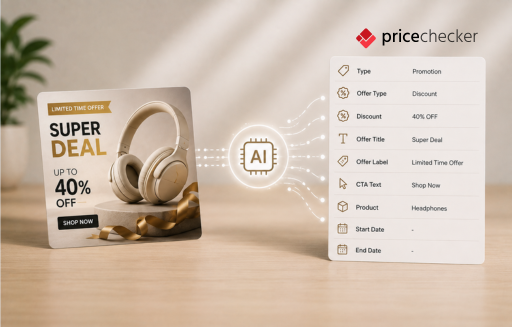
AI helps bridge this gap by converting visual content into structured information.

Using techniques such as image-to-text recognition and visual parsing, systems can:

  • Detect text within images (e.g. “20% off”, “3 for 2”)
  • Identify promotional badges and labels
  • Interpret placement and context of visual elements

This allows a competitive intelligence tool to capture promotions that would otherwise remain hidden.

From Creative Assets to Structured Signals

The key value is not just detection, but interpretation.

AI can take visual inputs and translate them into usable signals for price tracking software, including:

  • Promotion type (e.g. percentage discount, multibuy)
  • Associated products or categories
  • Conditions implied by the creative

This turns unstructured visual content into something that can be analysed alongside pricing and competitor data.

Improving Promotion Coverage

With visual parsing in place, promotion tracking becomes more complete.

Retailers can:

  • Capture both structured and unstructured promotions
  • Reduce gaps in competitor monitoring
  • Build a more accurate view of competitor activity

This is particularly important in categories where promotional intensity is high and messaging changes frequently.

Supporting Better Pricing Decisions

More complete data leads to better decisions.

When visual promotions are included, pricing teams can:

  • Respond to the full range of competitor activity
  • Avoid underestimating promotional pressure
  • Maintain a clearer view of true market position

Reliable competitor intelligence depends on capturing what shoppers actually see—not just what systems can easily read.

From Visible Content to Usable Data

Retail websites are designed for people, not for data extraction.

As a result, some of the most important pricing signals sit outside traditional structures.

AI allows pricing systems to adapt to this reality—turning visible content into usable data without relying on rigid formats.

Final Thought

Promotions are increasingly visual.

If pricing systems only capture structured data, they will miss part of the picture.

By using AI to interpret promotional images, retailers can close that gap—bringing more of the real market into view.

And in most cases, that is what allows competitor monitoring software to reflect not just what is coded on the page, but what is actually being communicated to shoppers.

Don't want to miss anything?

Grow your business with the latest eCommerce updates

This field is for validation purposes and should be left unchanged.