pricechecker

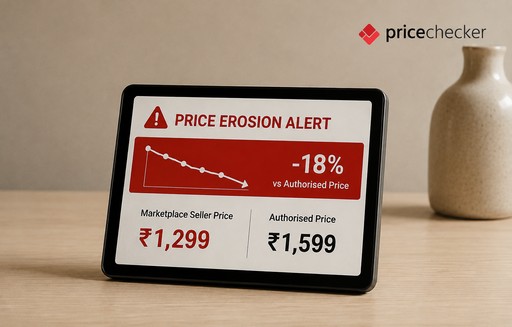
Price erosion on marketplaces rarely happens all at once.

It tends to build gradually, with one seller lowering the price to win the buy box, another following, and over time a new, lower benchmark forming. For brands selling on platforms like Amazon or Walmart Marketplace, this can happen quietly in the background.

By the time it becomes visible in headline pricing, the shift is often already established.

How Marketplace Dynamics Drive Erosion

Unlike traditional retail, marketplaces are decentralised.

Multiple sellers list the same product, each with their own objectives:

  • Clearing stock quickly
  • Winning the buy box
  • Driving volume over margin

From a competitor tracking perspective, this creates a continuous cycle of adjustment.

A small price drop by one seller can trigger a chain reaction, particularly in competitive categories.

The Role of Unauthorised and Aggressive Sellers

Not all sellers operate with the same intent as the brand.

Some may:

  • Source products through secondary channels
  • Discount more aggressively than intended
  • Ignore recommended pricing guidelines

These sellers can introduce price points that sit outside the brand’s desired positioning.

From a competitor pricing analysis perspective, they often appear as outliers, but their impact can be disproportionate if they gain visibility.

Why Price Erosion Is Hard to Spot Early

Erosion does not always show up as a clear event.

Instead, it appears as:

  • Gradual downward movement across multiple sellers
  • Increasing frequency of lower-priced offers
  • Shifts in which sellers win the buy box

Because these changes are incremental, they can be missed in standard price monitoring software that focuses on current price rather than movement over time.

Understanding Which Prices Matter

Not every low price affects the market equally.

Some sellers may have:

  • Limited stock
  • Lower visibility
  • Slower fulfilment

Others may consistently win the buy box, making their pricing far more influential.

A competitive intelligence tool that accounts for seller prominence, availability, and fulfilment helps identify which price movements are actually driving erosion.

Bringing Structure to Marketplace Pricing

To detect erosion effectively, brands need more than snapshots.

A robust competitive pricing tool will:

  • Track price movement over time across all sellers
  • Highlight sustained downward trends
  • Distinguish between isolated discounts and systemic shifts
  • Align pricing data with seller behaviour and visibility

This turns fragmented marketplace data into a clearer trend.

The Impact on Brand Positioning

Unchecked erosion affects more than margin.

It reshapes how a product is perceived:

  • Lower visible prices can reset customer expectations
  • Premium positioning can be diluted
  • Retail partners may feel pressure to follow

Without visibility, brands may not realise how far pricing has drifted until it becomes difficult to recover.

Supporting Early Intervention

The earlier erosion is identified, the easier it is to manage.

With reliable competitor intelligence, brands can:

  • Identify which sellers are driving price declines
  • Engage with distribution partners
  • Adjust supply or channel strategy
  • Reinforce pricing expectations where possible

This is not about reacting to every price change, but understanding when a pattern is forming.

From Isolated Prices to Market Trends

Marketplace pricing is fluid.

Looking at individual price points is not enough to understand what is happening.

A price tracking software that focuses on trends, rather than snapshots, provides a clearer view of how pricing is evolving.

Final Thought

Price erosion on marketplaces is rarely obvious at the moment.

It develops gradually, shaped by multiple sellers acting independently.

For brands, the risk is not just that prices fall, but that they fall unnoticed.

By tracking seller behaviour and pricing trends through competitor monitoring software, it becomes possible to spot erosion early and respond before it reshapes the market.

And in most cases, that is what protects both margin and brand position over time.

Don't want to miss anything?

Grow your business with the latest eCommerce updates

This field is for validation purposes and should be left unchanged.