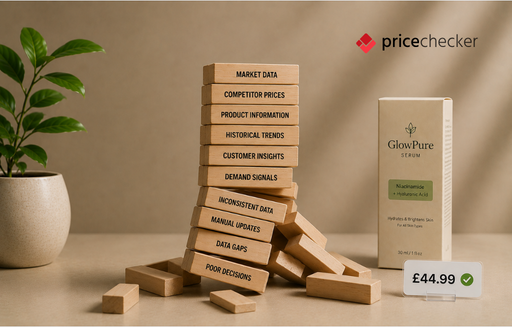
Pricing strategy tends to look straightforward on paper. Set clear rules, monitor competitors, adjust where needed, and maintain a consistent position in the market.
At a smaller scale, that approach can work reasonably well.
At enterprise scale, it rarely holds together without one key ingredient: stable, consistent data.
Most retailers already have some form of price monitoring software or competitor monitoring software in place. The intention is right, but the goal is to bring structure to pricing and respond to the market with confidence.
The challenge is that as catalogue size grows, even small inconsistencies in data begin to multiply. What works across a few hundred products becomes far more difficult to manage across tens or hundreds of thousands.
The Reality of Pricing at Scale
As product ranges expand, so does complexity.
Different categories behave in different ways. Competitor sets vary by product. Pricing rules that make sense in one part of the catalogue may not apply elsewhere.
To manage this, enterprise teams rely heavily on data from competitor tracking and competitor intelligence systems. That data feeds into pricing rules, reporting, and increasingly, automation.
When the data is stable, this creates a structured, repeatable process.
When it is not, the same process begins to break down.
How Instability Creeps In
Data instability does not usually come from a single issue. It tends to build gradually through a combination of factors:
- Inconsistent product matching across competitors
- Variations in data structure between feeds
- Gaps or delays in pricing updates
- Uneven competitor coverage across categories
At a smaller scale, these issues can be managed manually. At enterprise scale, they become harder to detect and correct.
The result is that different parts of the catalogue are effectively operating on different versions of the truth.
The Impact on Pricing Consistency
One of the first signs of unstable data is inconsistency in pricing decisions.
Two similar products may be treated differently because the underlying competitor data is not aligned. One may appear uncompetitive and trigger a price change, while the other does not, even if their market position is broadly the same.
Over time, this creates a fragmented pricing strategy.
Instead of a coherent approach across a category or range, pricing becomes a series of localised decisions, each influenced by slightly different data inputs.
For retailers aiming to maintain a clear market position, this can be difficult to manage.
The Strain on Pricing Teams
Unstable data also has a direct effect on how pricing teams operate.
When outputs from a competitive intelligence tool or competitive pricing tool are inconsistent, teams begin to question them. This leads to additional validation work, including checking competitor sites, reviewing product matches, and sense-checking reports.
At scale, this slows everything down.
Rather than focusing on strategy and optimisation, teams spend more time resolving data issues. Reaction times to genuine market changes increase, and confidence in the system decreases.
Why Automation Amplifies the Problem
Automation is often introduced to manage scale more effectively.
Rules-based pricing and algorithmic approaches can handle large volumes of products far more efficiently than manual processes. However, they are entirely dependent on the quality of the data they receive.
If a price tracking software or competitor monitoring software is feeding in unstable data, automation will apply that instability at scale.
This can lead to:
- Unnecessary price fluctuations
- Missed opportunities to remain competitive
- Gradual margin erosion across large parts of the catalogue
In effect, automation makes the underlying data quality more important, not less.
Stability as the Foundation for Scale
For pricing strategy to hold at scale, consistency needs to come first.
Stable data means:
- Reliable, like-for-like product comparisons
- Consistent data structures across all feeds
- Regular, dependable updates
- Clear definitions of which competitors matter for each product
With these foundations in place, competitor pricing analysis becomes more coherent. Pricing rules behave more predictably, and automation can be applied with greater confidence.
This is where more robust approaches to competitor intelligence begin to show their value, not by adding more data, but by improving the quality and consistency of what is already there.
From Fragmentation to Control
When data is stable, pricing strategy becomes easier to manage across large product ranges.
Decisions are more consistent. Teams spend less time validating outputs. Automation supports the strategy rather than undermining it.
Perhaps more importantly, it becomes possible to maintain a clear position in the market, even as the catalogue grows.
Without that stability, pricing tends to drift, shaped by inconsistent inputs rather than deliberate strategy.
Final Thought
Scaling pricing is not just about handling more products. It is about maintaining control as complexity increases.
Most retailers already have the tools in place, whether through competitor monitoring platforms or broader pricing systems. The difference lies in how stable the underlying data is.
Because at enterprise scale, small inconsistencies do not stay small for long.
And without a consistent foundation, even a well-defined pricing strategy can start to come apart.