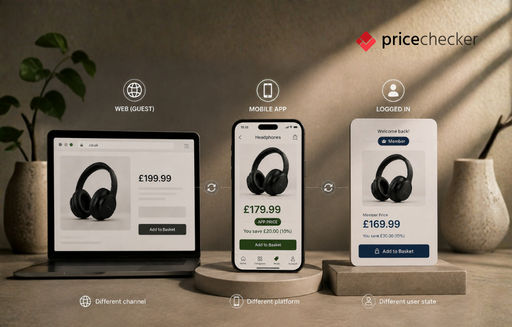
For many retailers, competitor price tracking still assumes a single, consistent price per product.
In reality, that assumption no longer holds.
Today, pricing can vary depending on where and how a customer interacts with a retailer, whether through the website, a mobile app, or as a logged-in user. For enterprise teams relying on price monitoring software or competitor monitoring software, this introduces a level of complexity that is not always visible at first glance.
One Product, Multiple Prices
It is increasingly common for a single product to have multiple valid prices at the same time.
A customer browsing the website as a guest may see one price. The same product, viewed through a retailer’s app, may be discounted. A logged-in user with purchase history or loyalty status may see a further variation.
From a customer perspective, this is part of a more tailored shopping experience.
From a competitor tracking perspective, it creates a more fragmented market.
The question is no longer “what is the price?”, but “which price are we comparing against?”
The Limits of Single-View Pricing Intelligence
Many competitive intelligence tools are built around a single capture point, typically the publicly visible web price.
While this provides a consistent reference, it does not always reflect the full range of pricing available to customers.
As a result, competitor pricing analysis may be based on only part of the picture. Retailers may appear aligned with the market on the web, while competitors are offering more competitive pricing through apps or logged-in experiences.
This creates a gap between perceived competitiveness and actual customer experience.
Why Channel and State Matter
Different channels and user states often serve different commercial purposes.
Web pricing may act as a baseline. App pricing may be used to drive engagement or repeat usage. Logged-in pricing may support loyalty or targeted promotions.
Understanding these layers is important.
Without this context, pricing teams risk:
- Comparing against the wrong benchmark
- Missing targeted competitor activity
- Misinterpreting how aggressive competitors are being in the market
A price tracking software that does not distinguish between these states can only provide a partial view.
Managing Complexity at Scale
For enterprise retailers, tracking these variations across large product ranges is not straightforward.
Each additional layer, including web, app, and logged-in experiences, introduces more data points, more variability, and more potential for inconsistency.
To manage this, pricing teams need structure.
Rather than treating all prices as equal, more advanced competitor monitoring approaches segment data by channel and user state. This allows teams to:
- Compare like-for-like contexts
- Understand where pricing differences are most significant
- Prioritise responses based on strategic relevance
This is less about collecting more data, and more about organising it in a way that reflects how the market actually operates.
Maintaining Clarity in Decision-Making
With multiple price points in play, clarity becomes essential.
Pricing teams need to define which view of the market they are responding to. In some cases, the web price may still be the primary benchmark. In others, app or logged-in pricing may carry more weight, particularly in categories where mobile engagement is high.
Clear definitions help avoid confusion.
They ensure that outputs from a competitive pricing tool are interpreted consistently, and that pricing decisions are aligned with the most relevant view of the market.
The Role of Data Consistency
As with other areas of pricing intelligence, consistency is key.
If data across web, app, and logged-in states is not captured and structured in a consistent way, it becomes difficult to compare and interpret. Variations may appear larger or smaller than they really are, depending on how the data is presented.
Reliable competitor intelligence depends on maintaining that consistency, even as the underlying complexity increases.
Final Thought
Pricing is no longer a single number attached to a product.
It is a set of values that can change depending on channel, context, and customer.
For enterprise retailers, understanding this is essential.
Tracking prices across web, app, and logged-in states does introduce complexity, but it also brings pricing intelligence closer to how customers actually experience the market.
And in most cases, that is where more informed decisions begin.