For enterprise retailers, pricing is no longer just a commercial lever. It increasingly sits within a wider framework of compliance, governance, and brand accountability.
Whether driven by internal controls, supplier agreements, or external regulatory scrutiny, there is a growing expectation that pricing decisions can be explained, not just made.
Most retailers already have access to price tracking software or a competitive intelligence tool. The challenge is that having data is not the same as having a clear, defensible record of how and why pricing decisions were taken.
That distinction becomes critical when questions are raised.
Why Pricing Decisions Need to Be Explainable
At scale, pricing is rarely managed manually. Decisions are influenced by a combination of market data, internal rules, and increasingly, automation.
When everything is working as expected, this process is largely invisible. Issues tend to surface when there is a need to look back, such as during a compliance review, a supplier dispute, or an internal audit.
At that point, the requirement is straightforward:
Can the business demonstrate how a price was set, and what data informed that decision?
Without a structured audit trail, this becomes difficult to answer with confidence.
The Limits of Fragmented Data
In many organisations, pricing data exists across multiple systems. A competitor monitoring software platform may provide market visibility, while internal systems handle pricing execution, and separate tools track promotions or overrides.
Individually, each system serves a purpose. Collectively, they can create gaps.
Common challenges include:
- Inconsistent historical records
- Limited visibility of pricing changes over time
- Difficulty linking competitor data to specific pricing decisions
This fragmentation makes it harder to reconstruct events when required.
Even where competitor tracking is in place, the absence of consistent structure can leave pricing decisions open to interpretation.
What a Defensible Audit Trail Looks Like
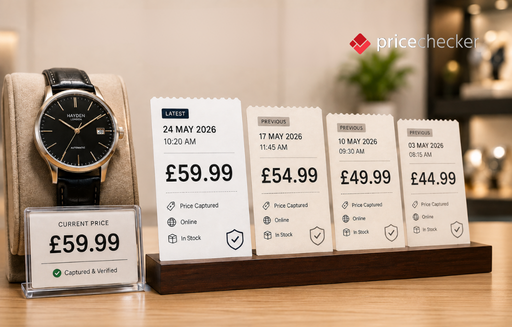
A defensible pricing audit trail is not simply a log of price changes. It is a structured record that connects three key elements:
- The price at a given point in time
- The market context (including competitor positioning)
- The logic or rule that led to the decision
When these elements are captured consistently, pricing becomes traceable.
For example, if a price was adjusted in response to competitor activity, a robust competitor pricing analysis should clearly show:
- Which competitor triggered the change
- Whether the product comparison was like-for-like
- How long that competitor price was in place
This level of detail turns pricing from a series of actions into a documented process.
Supporting Compliance and Regulatory Requirements
Regulatory expectations vary by market, but there is a common theme: transparency.
Authorities and partners are increasingly interested in how pricing decisions are formed, particularly in areas such as:
- Fair pricing practices
- Promotional integrity
- Consistency across channels
Without reliable data, responding to these requests can be time-consuming and uncertain.
With a structured audit trail, retailers are in a stronger position. They can demonstrate that pricing decisions were based on observable market conditions, supported by verifiable data from a price monitoring tool or competitor monitoring software.
This does not eliminate scrutiny, but it does provide a clear and consistent explanation.
Strengthening Internal Governance
Beyond external requirements, auditability plays an important role in internal governance.
Enterprise retailers often operate with multiple teams influencing pricing, including trading, pricing, marketing, and commercial functions. Without a shared, transparent record, it can be difficult to maintain alignment.
A well-structured audit trail helps to:
- Provide clarity on how pricing rules are applied
- Reduce reliance on informal knowledge or manual checks
- Support consistent decision-making across teams
It also creates accountability. When pricing decisions are visible and traceable, it becomes easier to review outcomes and refine strategy over time.
The Role of Data Consistency and Accuracy
As with most aspects of pricing, the quality of the audit trail depends on the quality of the underlying data.
If competitor data is inaccurate or poorly matched, the audit record becomes less reliable. A competitive pricing tool that cannot demonstrate like-for-like comparisons weakens the overall chain of evidence.
Consistency is equally important. Data needs to be captured in a standardised way across products, categories, and time periods. Without this, even accurate data can become difficult to interpret retrospectively.
This is where more mature approaches to competitor intelligence and pricing data management begin to stand out.
From Operational Data to Strategic Asset
When structured correctly, a pricing audit trail becomes more than a compliance requirement.
It provides a historical view of how the business has responded to the market. Over time, this can be used to:
- Identify patterns in competitor behaviour
- Evaluate the effectiveness of pricing strategies
- Inform future decision-making
In this sense, the same data that supports governance can also strengthen commercial performance.
Final Thought
Pricing will always involve a degree of judgement. Market conditions change, competitors behave unpredictably, and not every decision can be reduced to a simple rule.
However, for enterprise retailers, it is increasingly important that those decisions can be explained.
A defensible audit trail does not just answer questions when they arise. It also creates a foundation of transparency and consistency that supports both compliance and better pricing over time.
And in most cases, that starts with ensuring that the data feeding your competitor monitoring software and price tracking software is structured, accurate, and dependable.